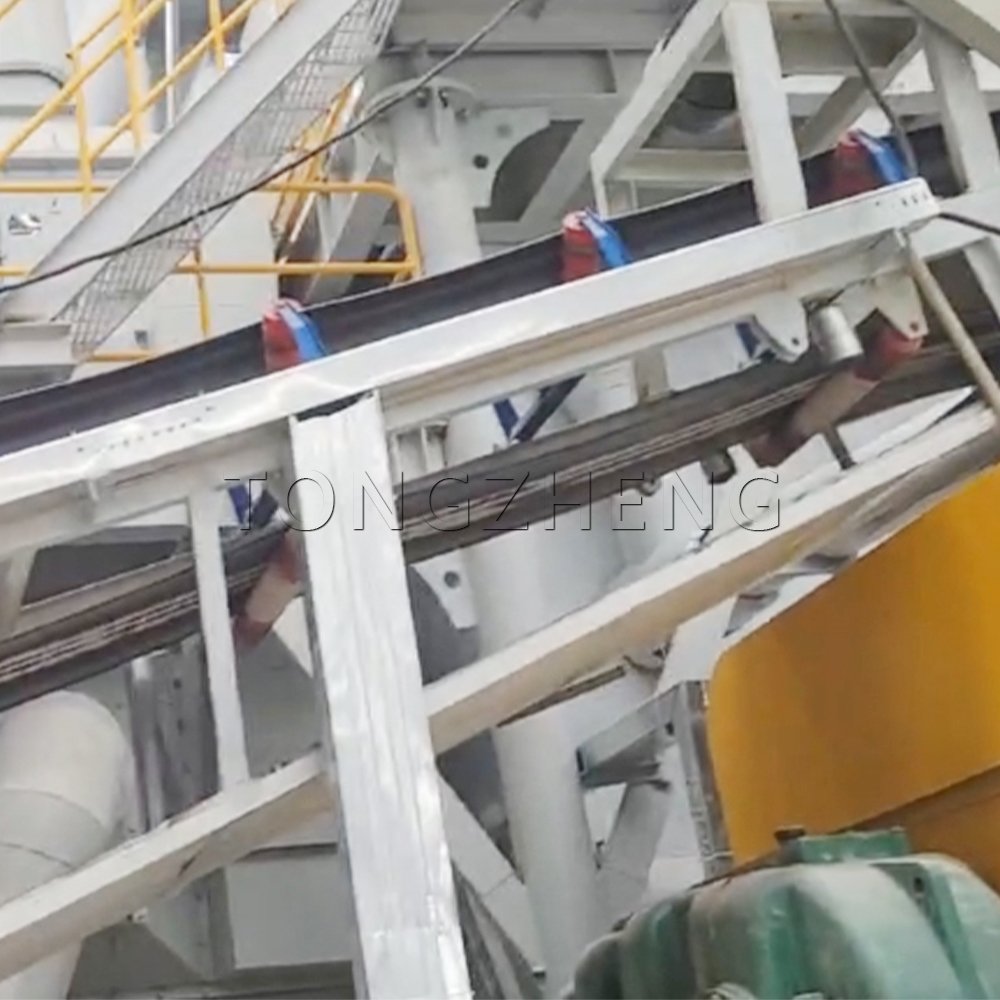
Belt Conveyor
The TONGZHENG Belt Conveyor provides smooth and continuous transportation of bulk materials, ensuring stable material flow between different processing stages.
- Trademark / Brand: TONGZHENG
- Place of Origin: Yancheng, Jiangsu, China
- Type: Belt Conveyor
Categories: Conveying Equipment
Product information
Product description
Product Overview
The TONGZHENG Belt Conveyor provides smooth and continuous transportation of bulk materials, ensuring stable material flow between different processing stages. It is designed for efficient handling of large material volumes, making it suitable for continuous-duty industrial production lines. A robust frame and high-quality conveyor components provide excellent load-bearing capacity and reliable performance under demanding conditions. The practical structural design facilitates installation, inspection, belt adjustment, and replacement of wear components. With belt widths from 500 mm to 2400 mm and conveying capacities matched to belt speed and material characteristics, the belt conveyor is a dependable solution for bulk material conveying in building-material, mining and powder-processing industries.
Key Features
Continuous Conveying
Provides smooth and continuous transportation of bulk materials, ensuring stable material flow between different processing stages.
High Conveying Capacity
Designed for efficient handling of large material volumes, making it suitable for continuous-duty industrial production lines.
Reliable and Durable
Robust frame and high-quality conveyor components provide excellent load-bearing capacity and reliable performance under demanding conditions.
Easy Maintenance
Practical structural design facilitates installation, inspection, belt adjustment, and replacement of wear components.
Technical Specifications
The following technical data are from the TONGZHENG belt conveyor selection sheets.
Table 1: Belt Width and Applicable Lump Size
| Belt Width (mm) | Lump Size (mm) |
|---|---|
| 500 | 100 |
| 650 | 150 |
| 800 | 200 |
| 1000 | 300 |
| 1200 | 350 |
| 1400 | 350 |
| 1600 | 350 |
| 1800 | 350 |
| 2000 | 350 |
| 2200 | 350 |
| 2400 | 350 |
Note: Lump size refers to the linear dimension of the material lumps.
Table 2: Belt Speed, Belt Width and Conveying Capacity
| Belt Width (mm) | 0.8 m/s | 1.0 m/s | 1.25 m/s | 1.6 m/s | 2.0 m/s | 2.5 m/s | 3.15 m/s | 4.0 m/s | 4.5 m/s | 5.2 m/s | 5.6 m/s | 5.6 m/s |
|---|---|---|---|---|---|---|---|---|---|---|---|---|
| 500 | 68 | 87 | 108 | 139 | 174 | 217 | - | - | - | - | - | - |
| 650 | 127 | 159 | 198 | 254 | 318 | 397 | - | - | - | - | - | - |
| 800 | 198 | 248 | 310 | 397 | 496 | 620 | 781 | - | - | - | - | - |
| 1000 | 324 | 405 | 507 | 649 | 811 | 1014 | 1278 | 1622 | - | - | - | - |
| 1200 | 593 | 742 | 951 | 1188 | 1486 | 1865 | 1872 | 2334 | 2674 | 2971 | - | - |
| 1400 | 825 | 1032 | 1321 | 1652 | 2065 | 2602 | 3273 | 3777 | 3718 | 4130 | - | - |
| 1600 | - | - | - | - | 2186 | 2733 | 3444 | 4373 | 4920 | 5466 | 6122 | - |
| 1800 | - | - | - | - | 2795 | 3494 | 4403 | 5591 | 6291 | 6989 | 7829 | 9083 |
| 2000 | - | - | - | - | 3470 | 4338 | 5466 | 6841 | 7808 | 8673 | 9717 | 11277 |
| 2200 | - | - | - | - | - | 6843 | 8690 | 9976 | 11786 | 10863 | 12166 | 14120 |
| 2400 | - | - | - | - | - | - | 8289 | 10526 | 11842 | 13158 | 14737 | 17104 |
Conveying capacity in t/h. (“-” = not applicable for this combination.)
Table 3: Drive Type and Drive Power
| Drive Type | Power Range (kW) | Note |
|---|---|---|
| Elastic coupling direct drive | 2.2-37 | Voltage 300V when power ≤ 200kW |
| Y-series motor with fluid coupling | 45-315 | Voltage 300V when power ≤ 200kW |
| Motorized pulley direct drive | 2.2-55 | Voltage 300V when power ≤ 200kW |
| Wound-rotor motor | 220-800 | Voltage 6000V when power ≥ 220kW |
Table 4: Idler Spacing of the Carrying Run
| Bulk Density (kg/m³) | Belt Width 500/600 mm | Belt Width 800/1000 mm | Belt Width 1200/1400 mm |
|---|---|---|---|
| Idler Spacing (mm) | |||
| ≤ 1600 | 1200 | 1200 | 1200 |
| > 1600 | 1000 | 1000 | 1000 |
Table 5: Bend Pulley Diameter Matching
| Belt Width | Driving Pulley Diameter | Tail Bend Pulley ≈180° | Head Bend Pulley ≈180° | Bend Pulley ≈90° | Bend Pulley <45° |
|---|---|---|---|---|---|
| 500 | 500 | 400 | 500 | 315 | 250 |
| 650 | 500 | 400 | 500 | 315 | 250 |
| 650 | 630 | 500 | 630 | 400 | 315 |
| 800 | 500 | 400 | 500 | 315 | 250 |
| 800 | 630 | 500 | 630 | 400 | 315 |
| 800 | 800 | 630 | 800 | 500 | 400 |
| 800 | 1000 | 800 | 1000 | 630 | 500 |
| 1000 | 630 | 500 | 630 | 400 | 315 |
| 1000 | 800 | 630 | 800 | 500 | 400 |
| 1000 | 1000 | 800 | 1000 | 630 | 500 |
| 1200 | 630 | 500 | 630 | 400 | 315 |
| 1200 | 800 | 630 | 800 | 500 | 400 |
| 1200 | 1000 | 800 | 1000 | 630 | 500 |
| 1400 | 800 | 630 | 800 | 500 | 400 |
| 1400 | 1000 | 800 | 1000 | 630 | 500 |
Table 6: Idler Types
| Category | Idler Types |
|---|---|
| Carrying idlers | Troughing idler 槽型托辊; Troughing idler with forward tilt 槽形前倾托辊; Transition idler 过渡托辊; Impact idler (stationary) 缓冲托辊; Self-aligning idler 调心托辊 (Friction-type top aligning 摩擦上调心辊; Tapered top aligning 锥形上调心辊); Flat idler 平行托辊 (Friction-type flat top aligning 摩擦上平调心辊; Flat top idler 平行上托辊) |
| Return idlers | Flat return idler 平行托辊 (single 一节 |
What Is a Belt Conveyor?
A belt conveyor is a continuous conveying machine that moves bulk or packaged materials on an endless rubber belt supported by idlers and driven by a driving pulley. Material is loaded at one end, carried along the belt and discharged at the other end, making it one of the most economical and widely used methods for transporting bulk materials over short and medium distances. The belt conveyor can be laid out horizontally or inclined, and its conveying capacity depends on belt width, belt speed and material bulk density. Thanks to its simple structure, smooth operation and low energy consumption, the belt conveyor is a standard conveying solution in cement plants, mineral processing and building-material production lines.
Applications
- Continuous conveying of bulk materials between crushing, drying, grinding and storage stages
- Feeding and transfer of raw materials, additives and finished products in building-material plants
- Bulk material handling in mining, aggregate and powder-processing industries
- Long-distance horizontal and inclined conveying on industrial production lines